
- PawsFourThought Guide -
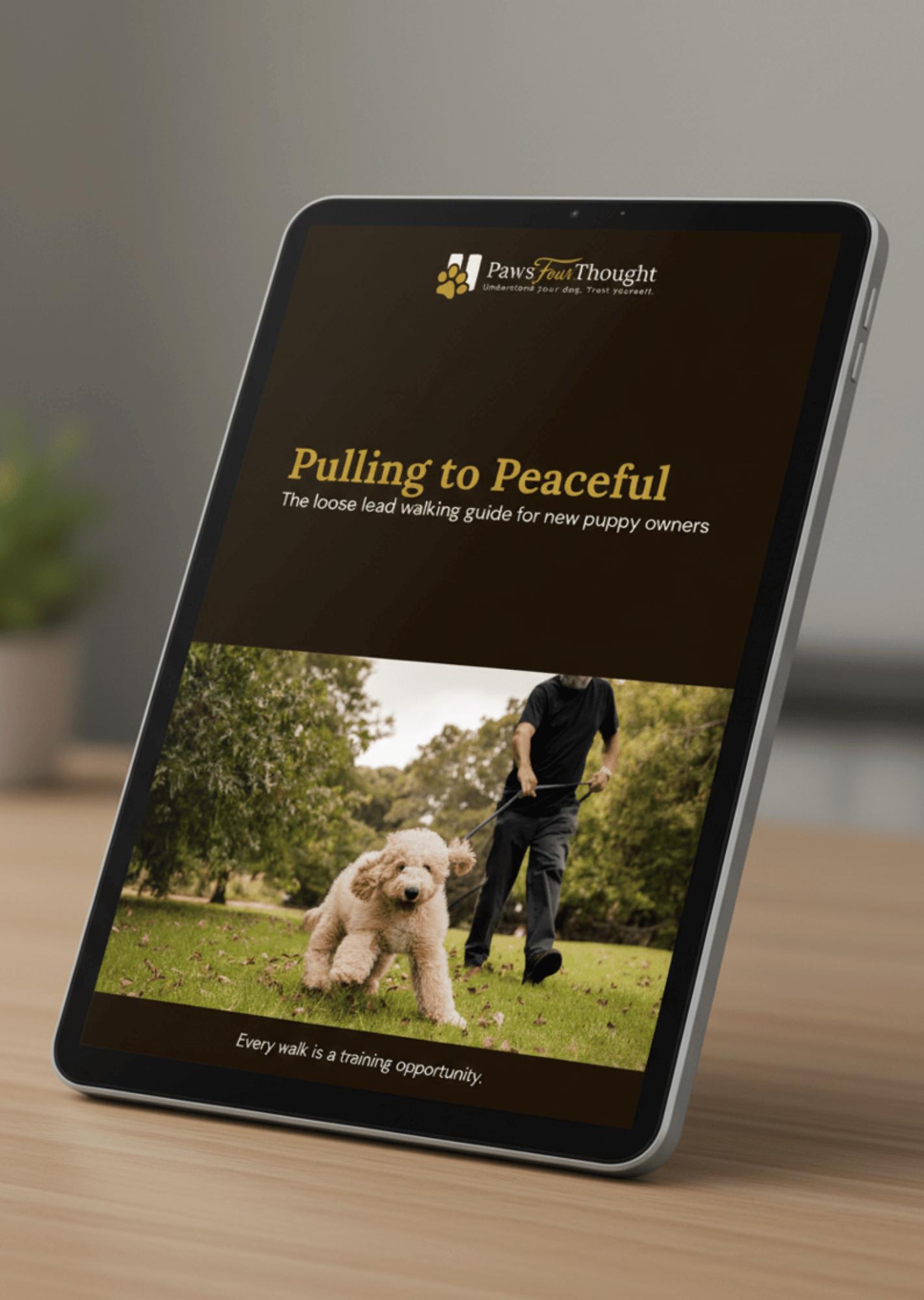
Pulling to Peaceful
Loose-lead walking — and the equipment question, answered honestly
Your shoulder aches, the lead is permanently taut, and everyone has a device that will fix it by the weekend. This is the one problem with a shop attached — which is exactly why the advice is so loud, and so contradictory.
HOME / PUPPY-GUIDES / PULLING-TO-PEACEFUL
“Make it uncomfortable and he’ll stop.” “Harnesses teach them to pull — they’re for sled dogs.” “Never let him walk out in front, he’ll think he’s in charge.” “A prong will fix it in one session — nothing else is this fast.” Every piece of advice arrives with total confidence, and most of it arrives with a product attached. Meanwhile your dog is still out in front, your arm is still aching, and you’re starting to wonder whether you’ve left it too late.
You haven’t, and your dog isn’t defying you. Around 82% of owners report that their dog pulls on the lead — the person being towed down the street, apologising to a neighbour, is the overwhelming majority of us. What’s different about this problem isn’t the dog. It’s that pulling is the one topic in puppy-raising argued over by an industry, and you’re being sold to at the exact moment you’re least sure.
What nobody tells you: your dog pulls because pulling works. The lamppost arrives, the grass verge arrives, the other dog arrives — dozens of times a walk, forward progress pays the pulling off. That’s the whole mechanism, and it’s why the honest fix is a bargain you strike over and over rather than a gadget you buy once. It’s also why the single most useful line in this guide is the one the shop can’t tell you: equipment manages the pull; training changes it.
There’s a clearer way through — and it starts with a reframe that changes the walk more than any technique: the walk isn’t a distance to cover. It’s the richest part of your dog’s day, and the sniffing is the point.
What this guide gives you
The one idea everything else rests on — the world is the reward. Your dog pulls because pulling has reliably, richly paid off their entire walking life. Change what it earns, and you change the pull. Everything in the guide is built on that single mechanism.
The line that ends both the harness guilt and the gadget hope: equipment manages the pull, training changes it. No harness, head collar or lead has ever taught a dog to walk nicely — so manage the pull so nobody gets hurt, and train the behaviour alongside.
The conflicting advice, sorted — including the equipment aisle, where the noise is loudest and the commercial pressure is real — so you can choose gear on the evidence rather than on the packaging.
What's inside
The debates that stall new owners — answered
A side-by-side audit of the nine loudest pulling debates — aversive tools, the sharp leash-pop, “harnesses make dogs pull,” pulling as dominance, the walk-as-exercise myth, retractable leads, whether a shorter lead really gives you more control, and the two questions that are genuinely contested: which equipment, and which method — with the science where it exists and an honest editorial position where it doesn’t.
Why they pull — and why it’s a welfare issue on both ends of the lead
Reinforcement, arousal and a simple mismatch of pace, laid out plainly — plus the honest case for solving pulling properly rather than suppressing it, including what the research measured about the force a collar concentrates on a pulling dog’s neck.
The kinds of walk
The idea that quietly fixes more walking problems than any technique: “a walk” isn’t one thing. The training walk, the sniffari, the honest A-to-B walk — and the everyday walk that all the training is quietly heading towards. Most walking frustration comes from running two of them at once.
The equipment question
A firm, welfare-led steer, with the reasoning shown: what to use if pulling isn’t established yet, what earns its place when it’s well rehearsed, where a head halter genuinely fits and where it doesn’t, why lead length matters more than owners expect — and what stays off the table for good.
Five stages, no timeline
Comfortable in the gear, Learning the loose lead, Sniffing freely, Busier places, Peaceful walks — each with the force-free methods that apply and a clear signal for when your dog is ready to progress, including the adolescent wobble built into the map rather than treated as failure.
When it’s more than pulling
How to tell ordinary pulling from lunging, fear or reactivity — and when a sudden change is worth a vet visit rather than more training.
PLUS! Two printable companion cards
The first is the loose-lead loop itself, drawn as a flow you can follow one-handed on the street — lead loose, mark and treat at your side, walk on; lead tight, be a tree, wait for the check-back, reward in position. The second covers the judgement calls: switching cleanly between “with me” and “go sniff,” spotting when your dog has tipped past “over it,” and what to do about a walk that’s simply gone badly. Designed to be printed and clipped to the lead, not read once and filed away.
PLUS! Included free — The PawsFourThought Approach
Our foundational guide and the framework behind everything we publish. It explains how we read the conflicting advice, where the science has settled, and how force-free training actually works — so this guide can get straight to the work without re-explaining the thinking each time.
GET INSTANT ACCESS
$20 NZD
Instant digital download · PDF guide + printable companion cards
Pulling today. Peaceful tomorrow. This guide shows you how to get there.
Science-backed, force-free. Pulling to Peaceful has been reviewed by Liz Clough, certified professional dog trainer with 20+ years of experience and PawsFourThought Training Partner.
Pulling to Peaceful is part of the PawsFourThought puppy guide suite. Check out our other topics like toilet training, socialisation and confidence work, and basic commands and manners.🐾

© 2026 PawsFourThought | Privacy Policy | Terms and Conditions


