
- PawsFourThought Guide -
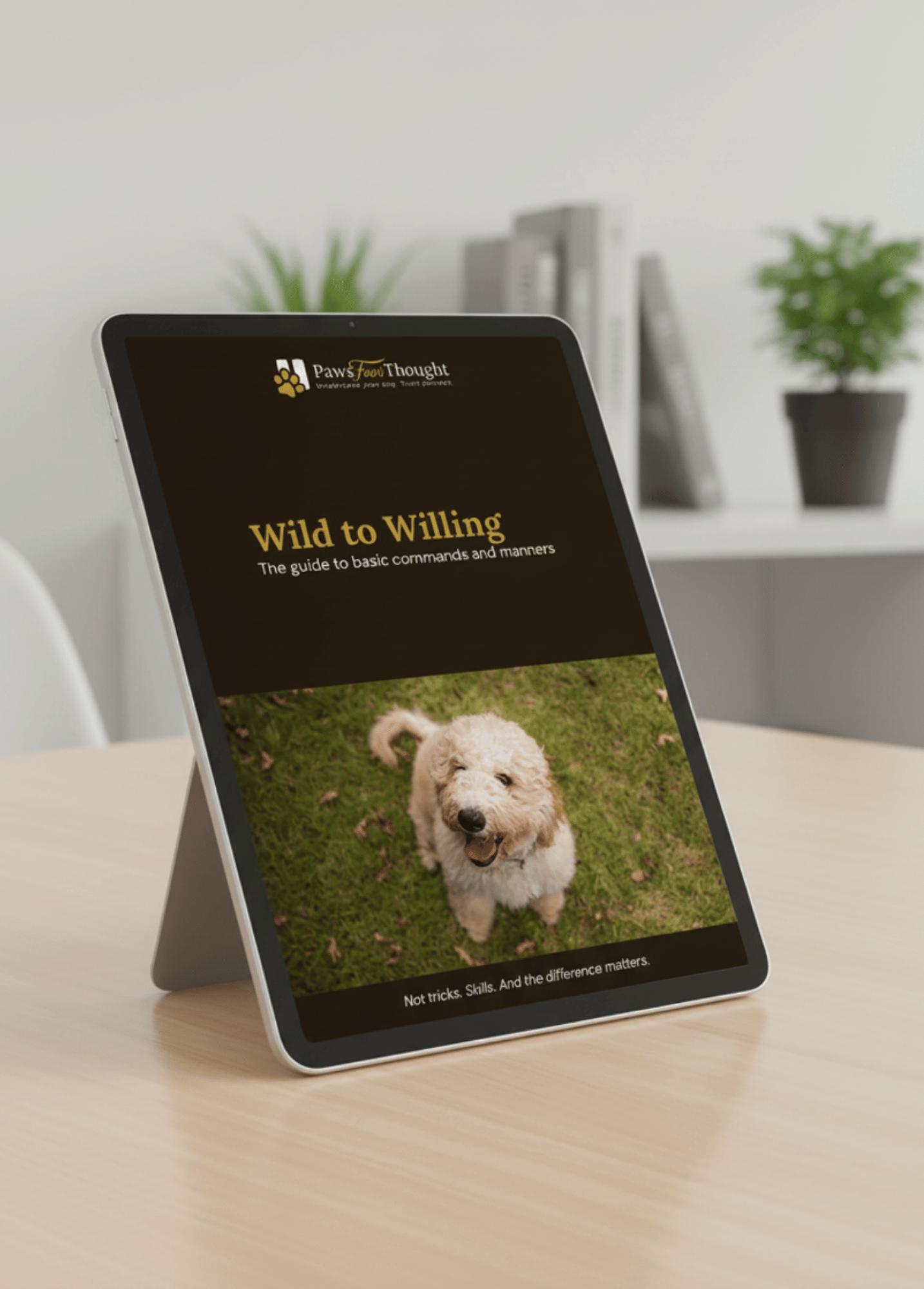
Wild to Willing
Basic commands and manners — taught as skills, not tricks
Your puppy sits beautifully in the kitchen and forgets it completely at the park. That's not stubbornness — it's a skill nobody showed you how to build to last.
HOME / PUPPY-GUIDES / WILD-TO-WILLING
One source says teach sit first. The next says sit is pointless. One says reward every time; another warns you’ll create a dog who only works for food. One swears by the clicker, one by a firm “no.” You’ve watched the videos and read the books, and the louder everyone gets, the less sure you become — and your puppy, handed a different rule every week, ends up as confused as you are.
Your puppy isn’t stubborn. You’re not failing. You’ve just been given a dozen contradictory methods and left to guess.
What nobody tells you: these aren’t just style differences. They’re the surface of a much bigger disagreement — about whether to use force at all, whether dogs need correcting or just teaching — and much of the loudest advice traces back to ideas the field moved past years ago.
There’s a clearer way through — and it starts with understanding that foundation skills aren’t a list of commands. They’re one connected capacity.
What this guide gives you
The five foundation skills every dog needs — engagement, sit and down, settle and stay, leave it and drop it, recall — taught in the order most puppies are ready to learn them.
The single idea that ties them together: impulse control. Not a pile of separate tricks, but one developing capacity to make good choices — which is why a puppy who has it learns new things faster and recovers from setbacks more easily.
The conflicting advice, sorted — so you stop second-guessing every decision and start teaching, confident you’re not doing it wrong.
What's inside
The debates that stall new owners — answered
A side-by-side audit of the loudest debates in foundation training — when to start, food versus praise, the name as a cue, wait versus stay, ignoring versus redirecting — with the science where it exists and an honest editorial position where it doesn’t.
Impulse control: the spine
Why sit, stay, leave it and recall are all the same underlying skill — and why building the capacity rather than the trick is what makes it hold up under real-world pressure.
Five stages, no timeline
Engagement, Early essentials, Learning to stay, Resisting temptation, Willing anywhere — each with the force-free methods that apply and a clear signal for when your puppy is ready to progress.
Reading your dog
What to do when your puppy won’t take treats — the most common training roadblock there is, and why it’s almost never refusal.
When things go wrong
Adolescent regression, the “stubborn” label, the dog who’s perfect at home but deaf at the park — the common patterns, and how to read and fix each one without starting over.
PLUS! Seven printable companion cards
The step-by-step how-to for every stage, plus quick-reference cards for the two things owners ask about most — a puppy who won’t take treats, and jumping up.
PLUS! Included free — The PawsFourThought Approach
Our foundational guide and the framework behind everything we publish. It explains how we read the conflicting advice, where the science has settled, and how force-free training actually works — so this guide can get straight to the work without re-explaining the thinking each time.
GET INSTANT ACCESS
$20 NZD
Instant digital download · PDF guide + printable companion cards
Wild today. Willing tomorrow. This guide shows you how to get there.
Science-backed, force-free. Wild to Willing has been reviewed by Liz Clough, certified professional dog trainer with 20+ years of experience and PawsFourThought Training Partner.
Wild to Willing is part of the PawsFourThought guide suite. More guides coming — socialisation, biting, crate training, walking on lead, and more.🐾

© 2026 PawsFourThought | Privacy Policy | Terms and Conditions


