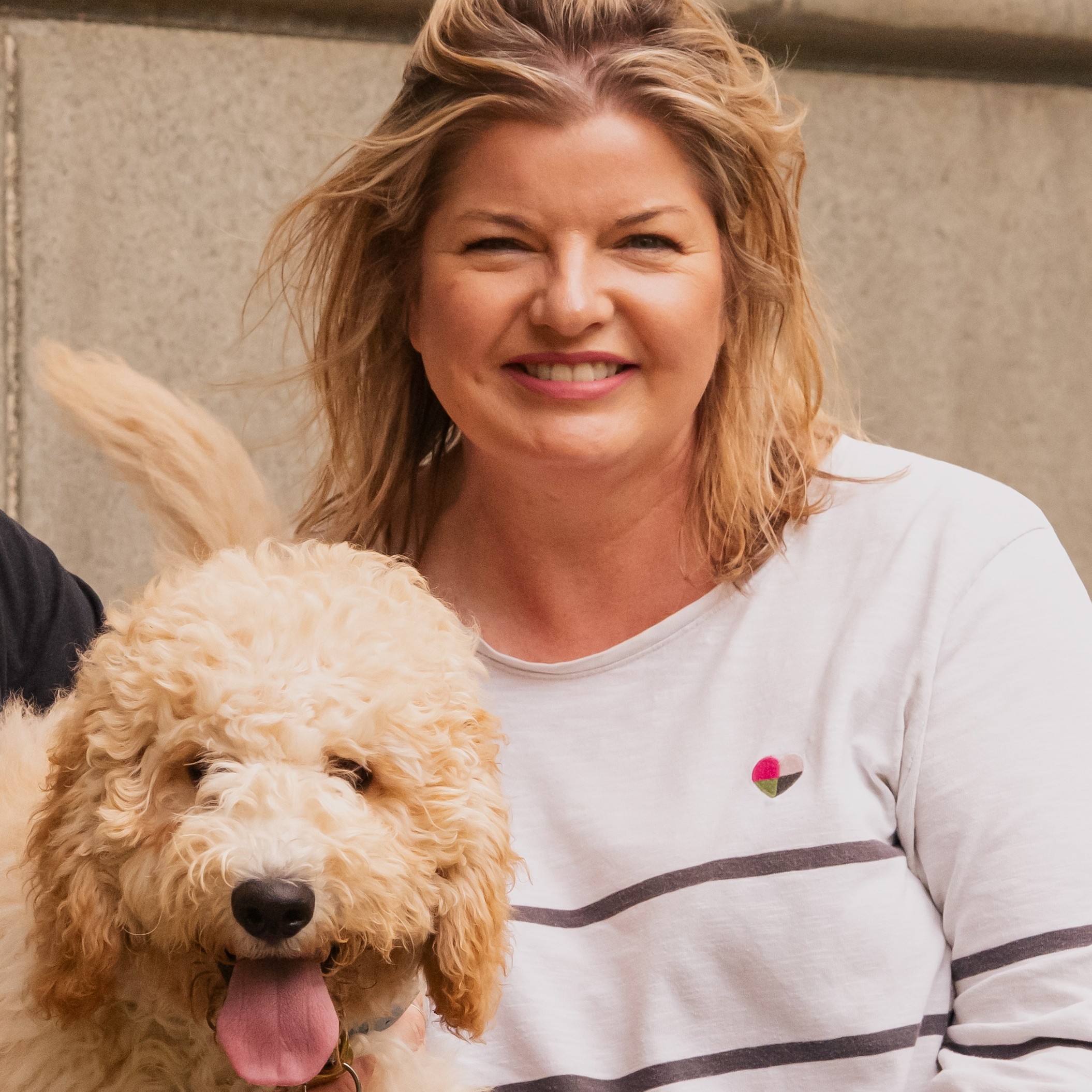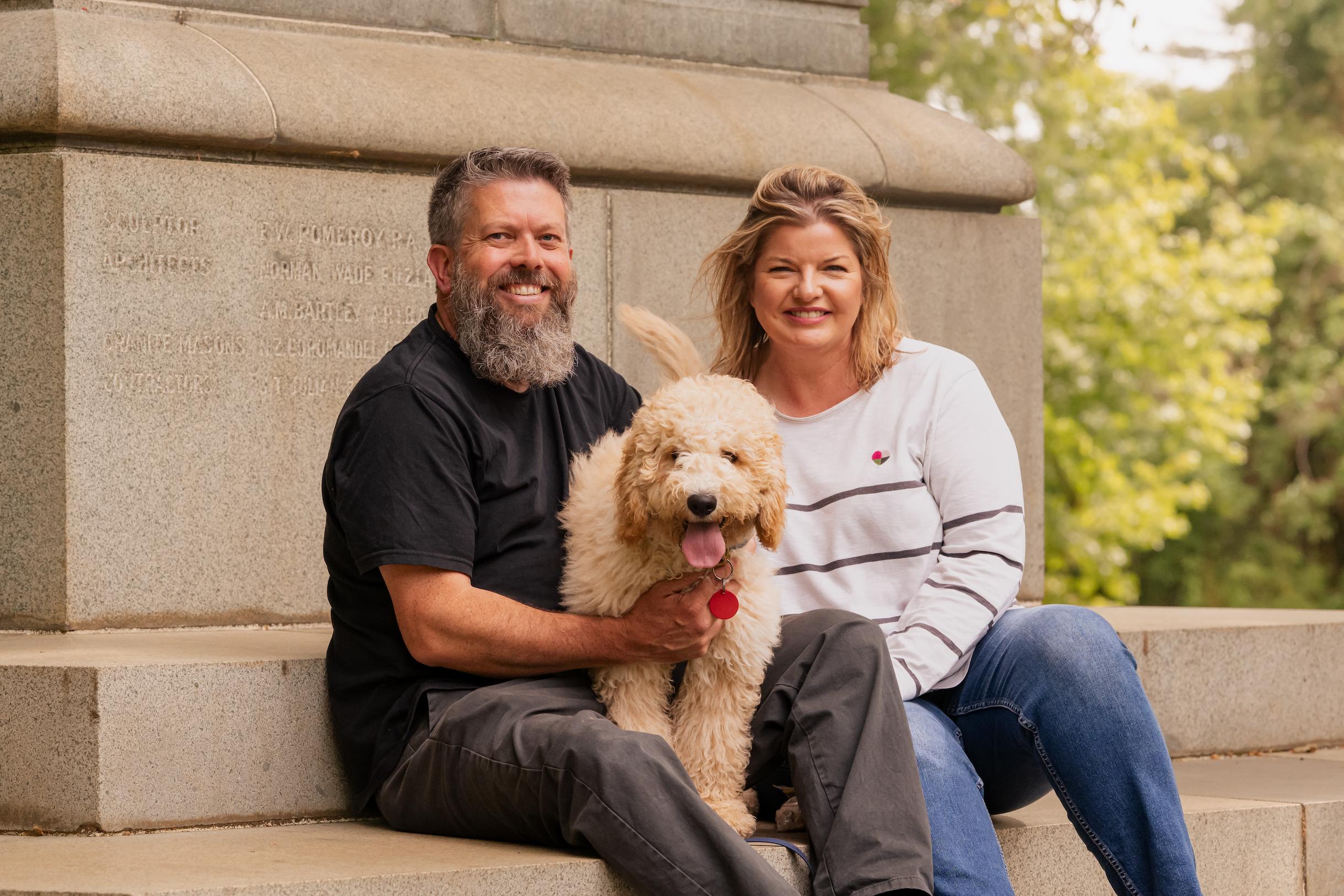
Why PawsFourThought? The real story behind the site
I want to tell you something that I'm still a little ashamed to admit.
A few weeks into life with our labraspoodle puppy Keith, I contacted our breeder about rehoming him.
I'm sharing that not to be dramatic, but because I suspect I'm not the only person who has sat in that place of pure desperation — exhausted, overwhelmed, questioning everything, wondering if getting a dog was the biggest mistake of their life. And if you're reading this from that place right now, I want you to know... it gets better. Dramatically, wonderfully better. But more on that in a moment.
First, let me tell you how we got here.
Colin — the dog who taught us what not to do
Before Keith, there was Colin. A miniature schnauzer, endlessly characterful, and deeply loved by our whole family.
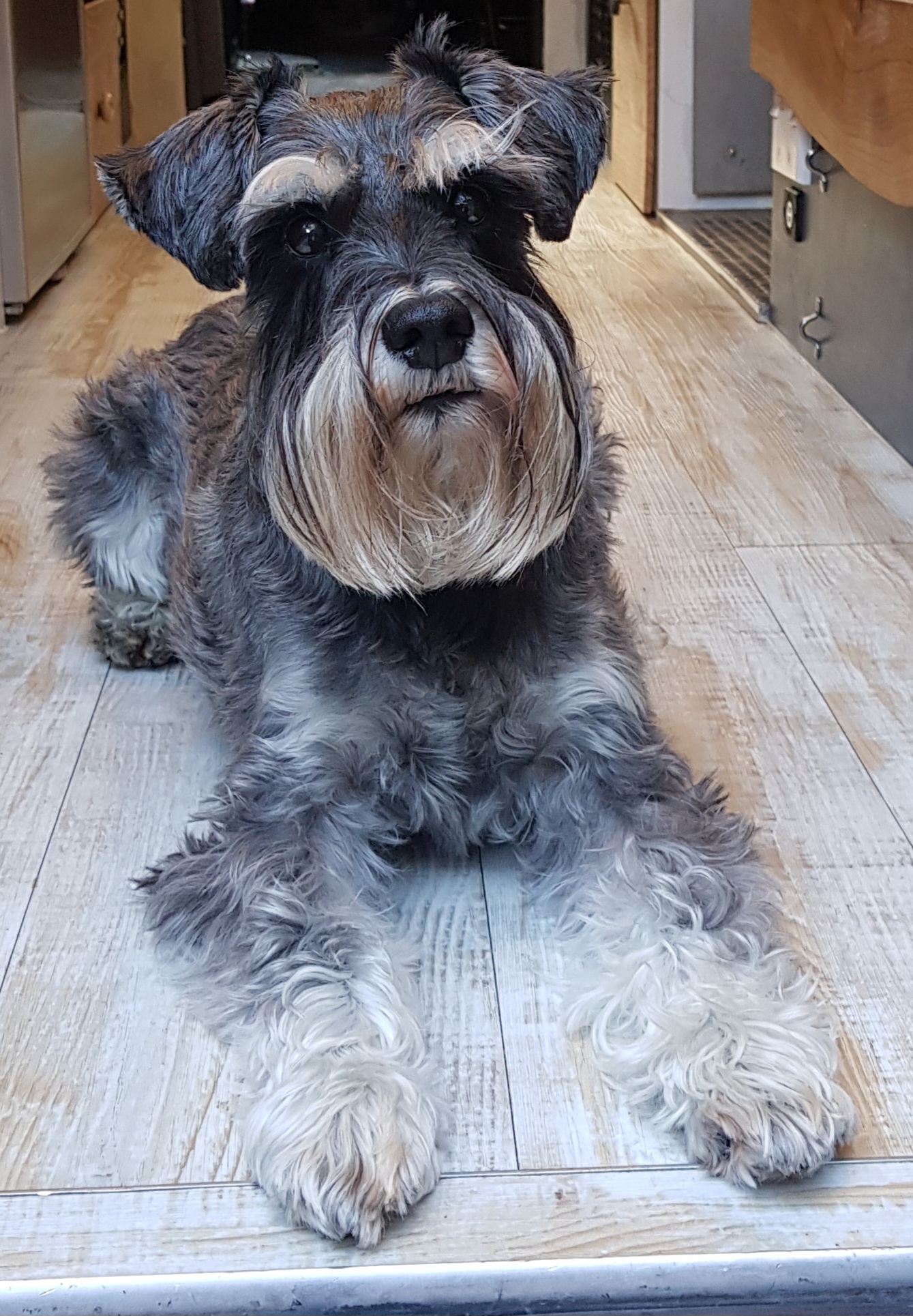
Photo: Colin
Colin was also, if we're honest, a bit of a nightmare — and it was entirely our fault.
We didn't socialise him properly in those critical early weeks. We didn't know enough to know what we didn't know. The result was a reactive, anxious dog who barked at everything, struggled with other dogs, and turned every walk into an ordeal. We stopped inviting people to the house. We dreaded bumping into other dogs on the street. We loved Colin completely and he had a wonderful life with us — but we always carried the quiet guilt of knowing things could have been different if we'd had better guidance early on.
When Colin died, we grieved deeply. And when we eventually felt ready for another dog, we made each other a promise: this time, we would do things properly.
We just had no idea how hard "properly" would turn out to be to define.
Keith arrives
We picked Keith up from his breeder at eight weeks old. When we arrived, we met two of his brothers — and immediately noticed that Keith was noticeably larger than both of them. The breeder had told us to expect a medium-sized dog, somewhere between 15 and 17 kilograms. Keith, it seems, has other plans.
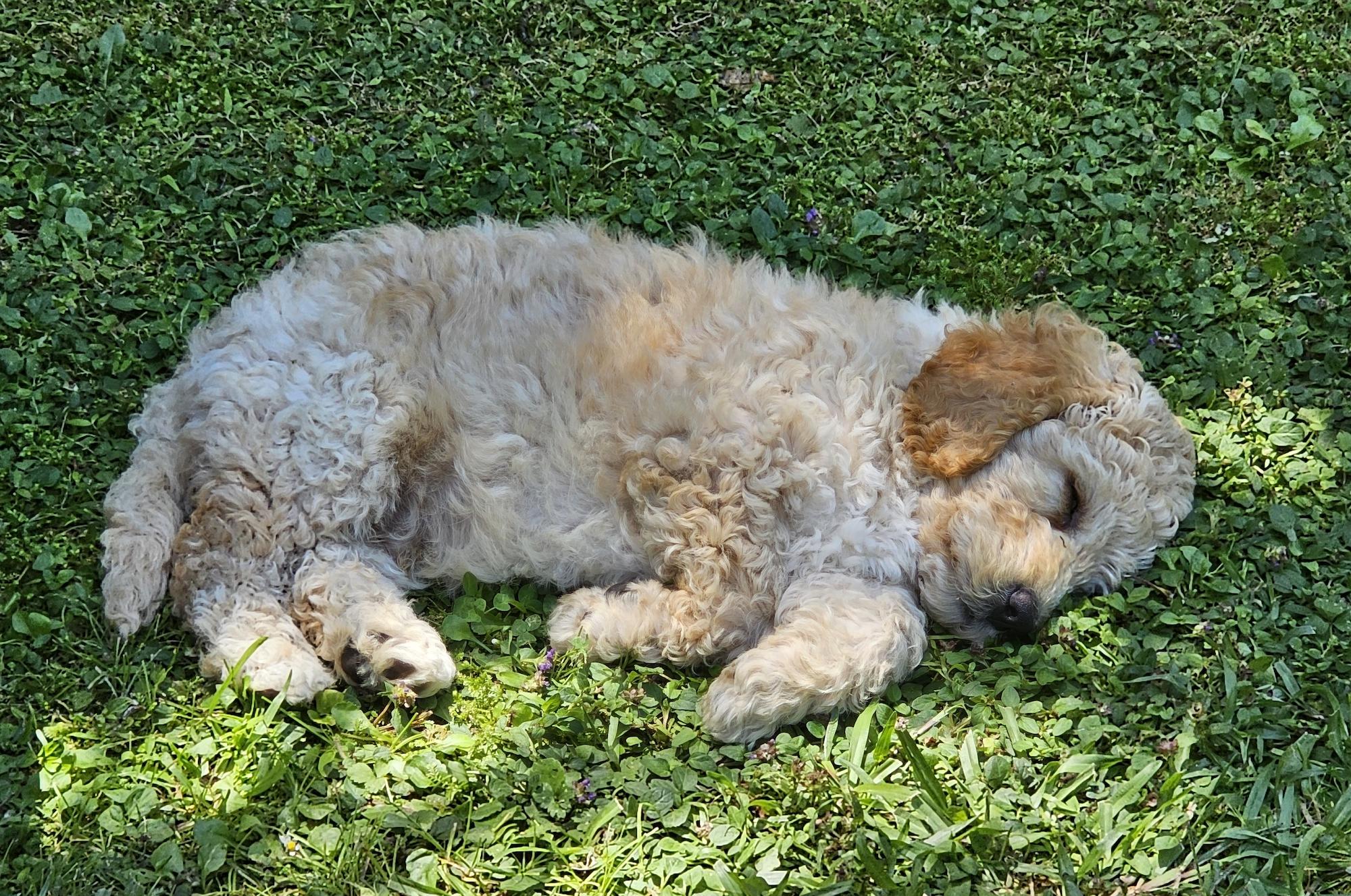
Photo: Keith at 8 weeks
At 16 weeks old he was already over 12 kilograms. A common rule of thumb is that you double a puppy's weight at 16 weeks to estimate their adult size. If that holds true, Keith may end up closer to 24 kilograms!
He was also, from the very beginning, a force of nature. Curious, playful, wriggly, and absolutely enormous for his age.
The breeder had done some early crate training, and we were told Keith was sleeping through the night. We knew this would likely change — being separated from his mum and siblings and thrust into an unfamiliar environment was inevitably going to be a wrench. But we felt prepared. We had puppy-proofed the house. Set up a pen and crate with easy access to the deck and garden. Bought the same food he was used to. Sourced a variety of toys. Joined a virtual puppy school run by a well-known dog behaviourist before he even arrived.
My husband Dan, ever practical, decided to sleep on the couch for the first few nights so he'd be right there if Keith got distressed. As it turned out, Keith woke around 2am for a toilet trip and then slept again until about 6am. Those first few nights were actually okay.
We felt cautiously optimistic. We had this.
Reader, we did not have this.
The information avalanche
The virtual puppy school started well enough. Keith responded to the week one guidance. We felt like we were on track.
But cracks appeared quickly.
The training videos always featured perfectly behaved demonstration dogs performing techniques flawlessly on the first attempt. What they never showed was what to do when your dog doesn't respond that way. There was no plan B. No "if your puppy does this instead, try this." Just a perfect example and the implication that you should achieve the same result.
The daily timetables were another source of quiet frustration. They'd say things like: 6am — toilet. 7am — breakfast. 8am — rest in crate. But what happens at 6.05am, when the toileting is done and Keith is bouncing around the garden? Or at 7.05am when breakfast has been inhaled in approximately forty-five seconds? The schedule assumed perfect execution and offered nothing for the gaps in between. We needed more detail. We needed someone to tell us what to actually do in those in-between moments.
The virtual school also encouraged us to seek out in-person puppy classes for socialisation — sensible advice, and something we were keen to do given our experience with Colin. We booked Keith into a five-week course. But it didn't start for another two weeks, and by then Keith had already begun jumping, humping, and biting with considerable enthusiasm.
None of that was covered in the virtual school materials.
So, we did what any reasonable person would do. We contacted the trainer running the in-person course and arranged a home consultation before the classes started.
What followed was the beginning of a confusion spiral that I wouldn't wish on any new dog owner.
When the experts disagree
The in-person trainer's advice was the complete opposite of the virtual school's.
Teach your puppy to be gentle when mouthing on skin, said one. It is never acceptable to allow teeth on skin — do a correction immediately to stop it, said the other.
Dogs respond best to routine, said one. Routines don't exist in the wild — wolves don't eat at the same time every day, so don't feed at fixed times, said the other.
The in-person trainer also recommended a book. I ordered it from Amazon immediately, read it cover to cover, and discovered it contained yet another entirely different set of recommendations.
We were a few weeks in with Keith and completely bamboozled.
The real casualty of all this conflicting advice was our consistency. One minute "sit" was the most important thing to teach. The next, "sit" was pointless and "wait" was the command to focus on. Should we enforce a routine or not? Were we pack leaders or was pack theory outdated nonsense? Every answer led to three more questions.
In desperation, I signed up for a fourth resource — another online puppy training course. With, inevitably, different advice again.
Keith, picking up on our confusion and inconsistency, got worse. Not because he was a bad puppy, but because we kept changing the rules on him. His jumping, humping and biting escalated. He was getting heavier and stronger by the day. And because of his vaccination protocol, we couldn't yet take him out for walks on public land — our socialisation solution was a pet stroller, which did at least produce some genuinely hilarious video footage of a rapidly growing labradoodle cruising through the neighbourhood in what can only be described as a pram.
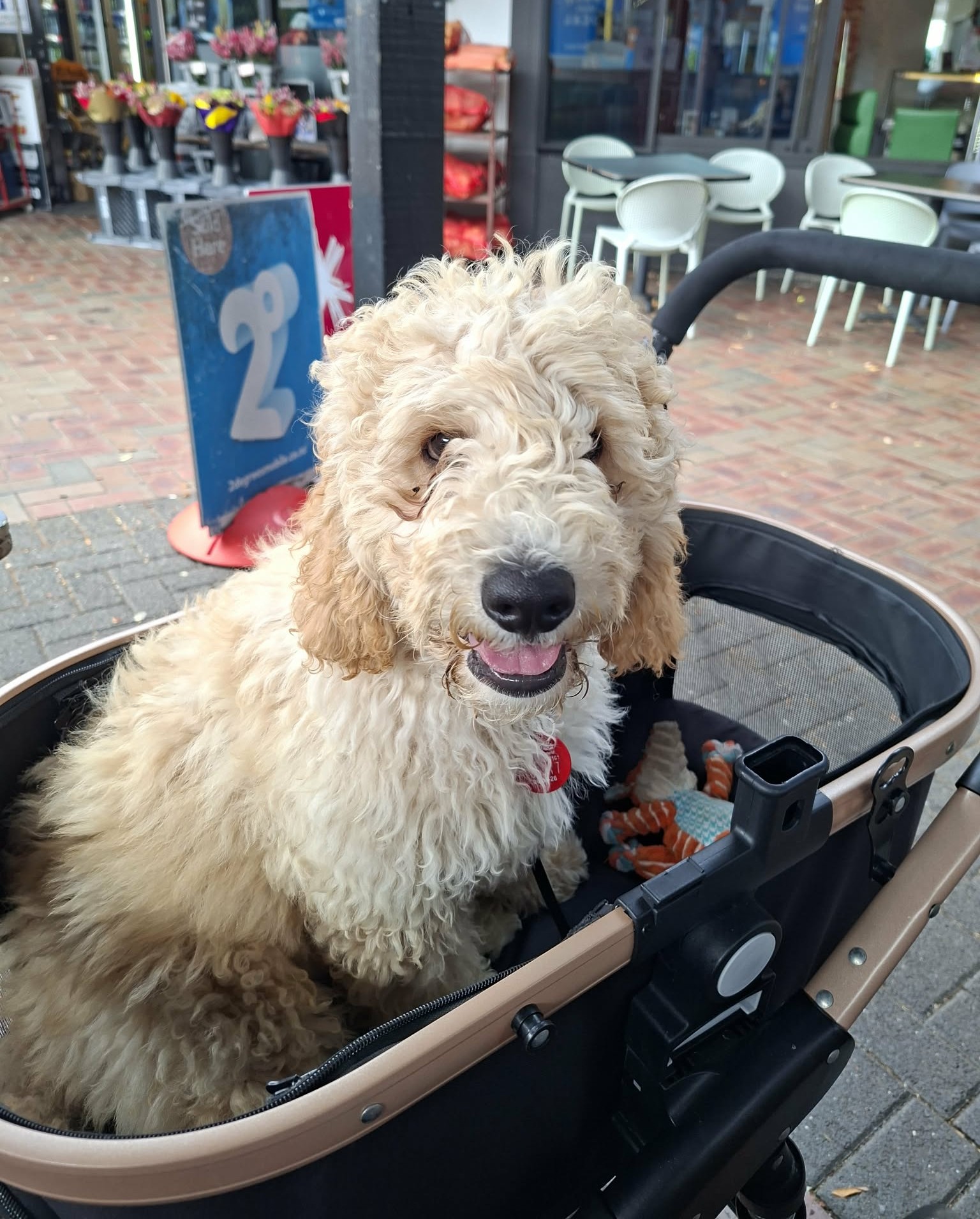
Photo: Keith at 14 weeks in the pram!
But the stress was building. Dan and I were exhausted and increasingly at odds about what to do. The pressure to "get everything right before 16 weeks" — that mythologised window during which, according to almost everyone, your dog's entire future personality would be determined — was overwhelming.
Things came to a head one weekend. Two days of pure dread. Dreading interactions with Keith. Dreading the biting. Dreading the jumping. Tears from both of us — genuine, tired, desperate tears.
And then I did the thing I still find hard to say out loud.
I emailed the breeder.
The email I'm not proud of
I asked about rehoming Keith.
We didn't go through with it. Something stopped us — the knowledge that we would regret it, the bond that was already forming even through the chaos, the nagging feeling that the problem wasn't Keith but the fact that nobody had given us the right tools.
But I want to be honest about that moment, because I think a lot of new dog owners arrive there and feel utterly alone in it. The shame of struggling with an animal you chose, that you love, that everyone expects you to be delighted by. The gap between what you imagined and what's actually happening at 11pm on a Sunday when you're covered in bite marks and running on four hours of sleep.
If you're in that place right now — please keep reading.
The thing nobody had told us
After that weekend, I threw everything at finding help. Friends. Facebook groups. Multiple trainers. I was casting the net as wide as I could.
And then I connected with a trainer who changed everything.
She asked us to describe Keith's typical day. We told her. She listened carefully and then said something that stopped me in my tracks.
Several people had mentioned, in passing, that puppies can sleep up to 20 hours a day. It had always felt like a fun fact rather than practical guidance. What our new trainer told us was different.
Puppies need 20 hours of sleep a day. Such a small shift in wording. Such an enormous difference in meaning.
Keith wasn't a difficult puppy. Keith was a chronically exhausted puppy whose impulse control — already limited at his age — was completely overwhelmed by tiredness. And because no one had told us that a young puppy will never voluntarily take himself off for a nap, we had been keeping him awake and engaged far longer than he could cope with.
Every training session we attempted during those mouthy, frantic moments was making things worse. We were trying to teach an overtired puppy, and overtired puppies cannot learn. They can only escalate.
The solution was almost embarrassingly simple. Any time Keith got mouthy, we popped him in his crate. Yes, he might whimper but generally within minutes, he was asleep.
We stopped trying to train him in those moments entirely. We gave him rest. And within days — days — we had a different dog.
From despair to something like joy
I want to be careful not to make this sound like a fairy tale, because Keith is now five months old as I write this and he is still very much a puppy. He still has his moments. He is wilful, boisterous and opinionated and given the chance will chew anything in sight!
But life with Keith is now, mostly, a genuine pleasure.
We can see the dog he's going to be. We can imagine the life we're going to have with him. The dread has gone. The tears have gone. What's replaced them is something that feels a lot like the relationship we always hoped to have — one built on patience, kindness, and an actual understanding of what he needs.
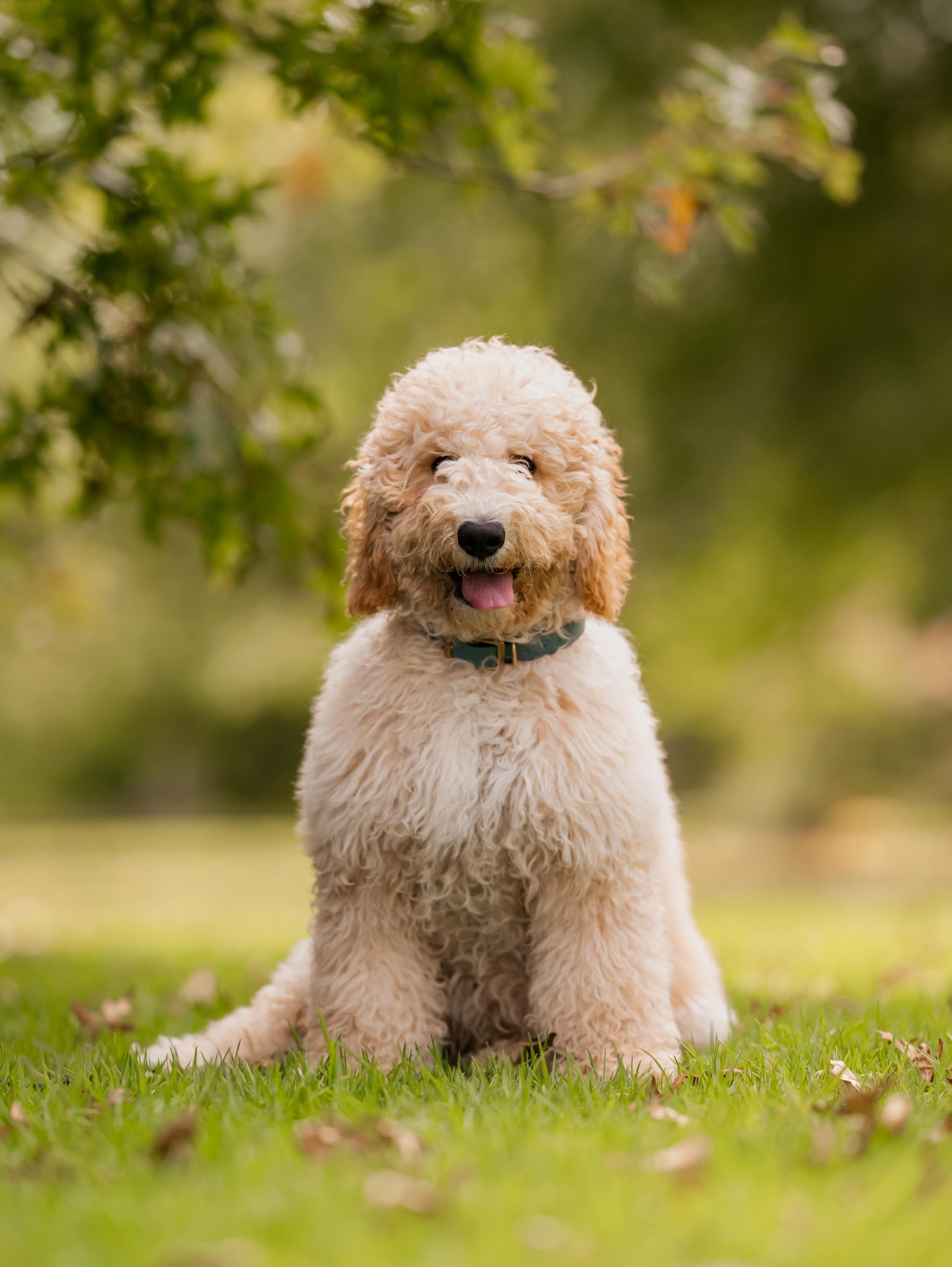
Photo: Keith at 5 months
Our trainer also explained something that reframed everything we'd been reading and hearing: pack theory — the basis for a significant amount of the conflicting advice we'd received — had been largely debunked about 15 years ago, in favour of positive reinforcement approaches that are kinder, more effective, and far better supported by modern science. A lot of the content we'd consumed was built on foundations that the dog training world had long since moved on from. We just hadn't known that.
Why this site exists
PawsFourThought exists because of everything I've just described.
Because of Colin, and the guilt of not knowing better. Because of the information avalanche that greeted us when we brought Keith home. Because of the contradictions, the conflicting experts, the vague timetables, the pressure of the 16-week window. Because of that desperate weekend and the email to the breeder. Because of the trainer who finally gave us clear, current, science-backed guidance — and the realisation that every new dog owner deserves access to exactly that.
The name comes from a play on "pause for thought" — that moment of stopping to think carefully before acting. The four is for Keith's four paws, and for every four-legged dog this site is here to help. It felt right.
Our goal is simple: to be the clear, honest, up-to-date resource we needed and couldn't find. To cut through the contradictions and give you guidance grounded in modern, positive-reinforcement science. To tell you not just what to do but why it works — and what to do when it doesn't go to plan.
We'll cover training, products, and everything in between. We'll tell you honestly when something isn't worth your money. We'll update our advice when better approaches emerge. And we'll share our ongoing story with Keith — including the bits that are still a work in progress.
Welcome to PawsFourThought
If you've just brought a new dog home — whether that's a puppy from a breeder or a rescue dog of any age — welcome. You're in the right place.
It's going to be wonderful. It's also going to be hard at times, confusing frequently, and occasionally the kind of tired you didn't know was possible.
We've been there. We're still in it. And we're here to help.
Keith says hello. He's just woken up from nap and is, for now, absolutely delightful. 🐾
Leanne Edwards is the founder of PawsFourThought, proud owner of Keith the labraspoodle, and the previous devoted owner of Colin the miniature schnauzer, who was loved beyond measure and is still very much missed.
A note: The trainer in this story is Liz Clough of K9 Services NZ. Since this was first written, she's become PawsFourThought's Training Partner — an NZQA CAM-CBT certified dog trainer with 20+ years' experience — reviewing every guide we publish for clinical accuracy before it goes live. Keith's trainer became the reason this site exists to the standard it does.