Not all dog training disagreements are equal...
... and nobody's telling you which ones are.
You've done the reading. You've watched the videos. You've joined the Facebook groups, followed the trainers, and bought or found at least one resource that contradicted the one before it.
And you've noticed something that nobody will quite admit: the experts don't agree. Not on everything — not even close. And when you try to work out who to trust, you hit a wall. They all sound authoritative. They all cite reasons. And you're left in the middle, trying to train your actual puppy, with a stack of conflicting instructions and no framework for working out which ones to follow.
Here's the thing nobody is telling you.
Not all disagreements are the same kind of disagreement.
Some of the conflicts you're encountering are genuine. The research is limited, the evidence points in more than one direction, and reasonable, qualified people have reached different conclusions. In those cases, your situation, your dog, and your judgment matter — because the science hasn't settled things yet.
But some of the conflicts you're encountering are not genuine disagreements at all. They're the echo of ideas that the evidence has moved on from — sometimes fifteen or twenty years ago — still circulating online because the internet doesn't have an expiry date. In those cases, one side of the debate isn't really a side. It's a legacy.
The problem is that from the outside, these two types of disagreement look identical. They're presented the same way, with the same confidence, by sources that are equally easy to find. And nobody — almost nobody — is telling you which type you're looking at.
The two types of disagreement
Type 1: Genuinely contested
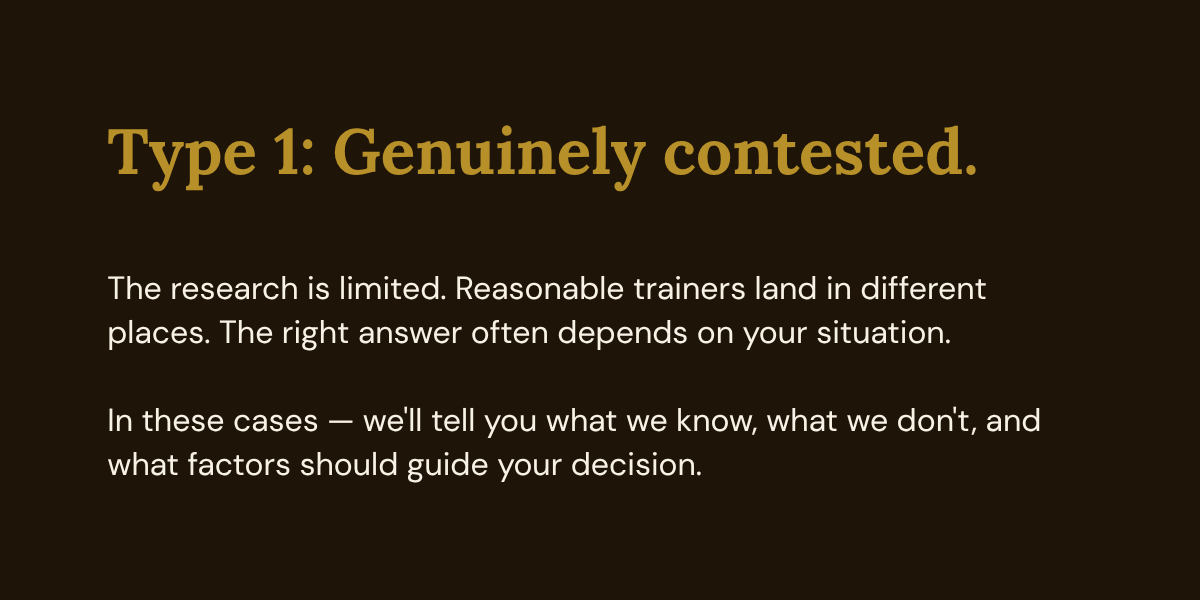
These are disagreements where the research is limited, the evidence is inconclusive, or the right answer legitimately depends on your specific situation. Reasonable, qualified trainers can land in different places — not because one of them is wrong, but because the science doesn't yet give a clear enough answer to settle things.
Puppy pads are a good example. You'll encounter strong opinions on both sides — use them, never use them — and both positions have a logical basis. The The honest truth is that this question hasn't been settled by direct comparative research. What we do know is that pads can teach dogs to seek out other absorbent surfaces, and that if outside access is available, most force-free trainers would steer you away from them. But if your living situation makes immediate outside access difficult? Pads are better than accidents on carpet.
That's a genuinely contested question. Your situation determines the answer more than the science does. And an honest resource should tell you that — rather than presenting one position as the obvious truth and ignoring the legitimate counterargument.
Type 2: Settled, but still circulating
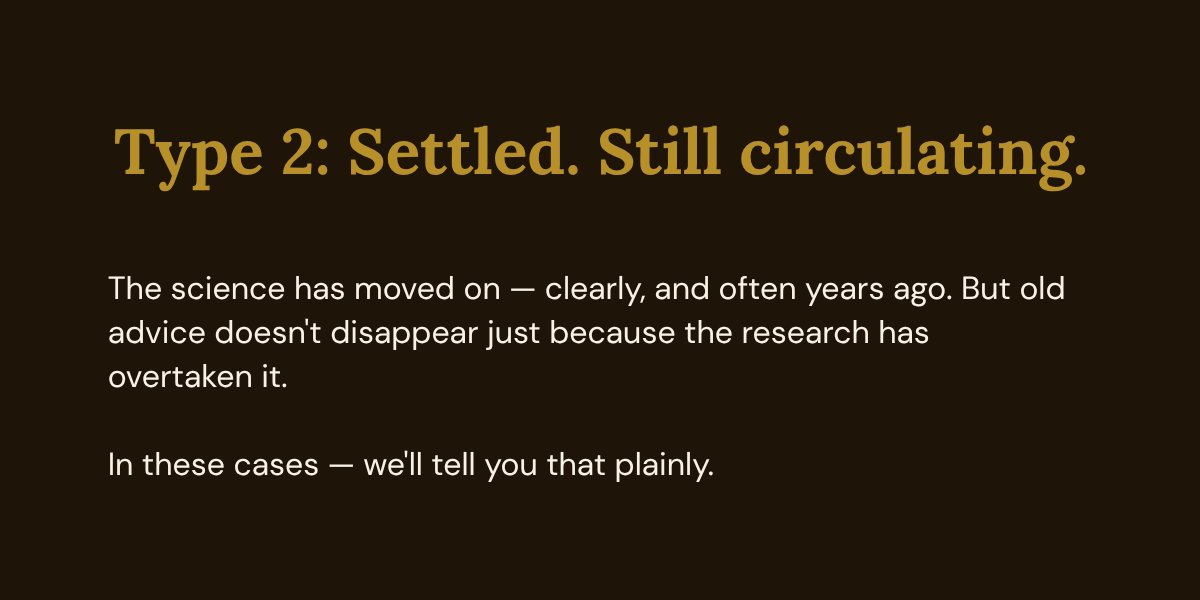
These are disagreements where the scientific evidence has actually moved on — clearly, consistently, and some time ago — but the old advice is still out there because the internet doesn't clear itself out. The authority of old sources doesn't fade just because the research behind them has been revised or overturned.
Punishment for toilet training accidents is the clearest example. You'll still encounter advice that a firm 'no' when you catch your puppy mid-accident is appropriate — that it interrupts the behaviour and communicates that it's wrong.
The research on this is not ambiguous. Punishment-based responses to accidents increase anxiety, damage trust between owner and dog, and make toilet training slower — not faster. A puppy who has been punished for accidents often starts hiding to eliminate, which makes supervision significantly harder. The harm is documented. The 'benefit' is not.
This isn't a debate. It just looks like one because both sides are still circulating.
Why it matters
If you treat a Type 2 disagreement like a Type 1, you waste time and energy trying to weigh up two positions as if they have equal merit. You might even choose the wrong one — not because you made a bad decision, but because nobody told you the decision had already been made.
And if you treat a Type 1 disagreement like a Type 2 — acting as if there's a clearly right answer when the evidence is genuinely limited — you might follow advice confidently that doesn't actually fit your dog, your home, or your situation.
The difference matters practically. A lot.
There's also something that happens to your confidence when you can't tell the disagreements apart. Every new piece of contradictory advice becomes evidence that you don't know what you're doing — that there's something obvious everyone else has figured out that you're missing. That feeling, it turns out, is extraordinarily common.
Research shows that 70% of new puppy owners experience symptoms of anxiety, depression, or both in their first months (ManyPets survey, 2023, n=857). Peer-reviewed studies put the rate at around half (Ståhl et al., University of Helsinki, 2024), with around one in ten experiencing severe symptoms. And a separate 2022 study (Merkouri et al., Frontiers in Psychology) identified what owners themselves said was making them anxious: the conflicting information.
Not the surplus of it — although there is a surplus. The fact that it all looks the same.

Photo: Keith, 5 months
What PawsFourThought does differently
Our promise — the one the tagline tries to capture — is not to add to the noise. Not to give you another opinion to weigh against the eight you already have.
But we also know that 'we won't add to the noise' can become a kind of cowardice. An excuse to present every disagreement as equally valid, hand you a list of options, and leave you to it. That's not help. That's delegation dressed up as balance.
So here's what we actually try to do.
When we walk you through an area where advice conflicts — and we do that deliberately, because ignoring the conflicts doesn't make them go away — we try to tell you clearly which type of disagreement you're looking at.
Where the evidence is genuinely limited: we'll say so. We'll tell you what we know, what we don't know, and which factors in your specific situation should inform your decision. We'll trust you with the uncertainty rather than pretending it doesn't exist.
Where the evidence has actually settled things: we'll say that too. We won't present the outdated position as a legitimate alternative just because it's still circulating. We'll tell you what the research supports, explain why, and give you the guidance that reflects it — clearly, without hedging.
Neither of those things is giving you an opinion. Both of them are reading the evidence honestly and telling you what it says.
The distinction in practice
In our guide Puddles to Progress, we work through eight areas where toilet training advice conflicts. Here's the difference in how those two types look on the page.
A genuinely contested one — cue word timing:
When do you say your cue word? Before your puppy goes, during, or after? All three approaches produce results. Saying the cue during elimination has the closest parallel to how cue words work in other training contexts — but the difference in outcome is small. This is a low-stakes debate. Pick an approach and be consistent. Your puppy will learn it either way.
A settled one — punishment:
The evidence here is consistent and unambiguous. Punishment-based responses to accidents — verbal corrections, nose-rubbing, any version of it — increase anxiety, slow training down, and damage trust. A puppy punished for accidents often starts hiding to eliminate, which makes supervision much harder. This isn't a debate. The science has moved on. We'll tell you that plainly rather than presenting it as a coin flip.
That's the difference. Not one list of opinions. Not false balance. An honest read of what the evidence actually says — and the clarity to tell you when it's spoken clearly.
Understand your dog. Trust yourself.
The tagline isn't a platitude. It's a description of what we're trying to build.
You can only trust yourself if you've been given honest information. Information that tells you where the real uncertainty lies, and where it doesn't. Information that respects your ability to make decisions for your specific dog, your specific home, your specific situation — while being straight with you about what the evidence supports.
That's what we're here for.
Not to add to the noise. To help you make sense of it.
The research underpinning PawsFourThought's editorial approach is explored further in: It's not just you. Science says new dog owners are drowning in conflicting advice — available at pawsfourthought.co.nz/post/what-the-research-says
Leanne Edwards is the founder of PawsFourThought. She is the owner of Keith, a labraspoodle who was briefly the subject of a rehoming enquiry and is now, mostly, an absolute delight. Suffering the confusion and consequences of conflicting advice is what inspired her to create PawsFourThought, so others don't have to experience the same thing. Every debate and every verdict in PawsFourThought's guides is checked by Liz Clough of K9 Services NZ — an NZQA CAM-CBT certified, force-free dog trainer with 20+ years' experience — before it's published.